Food Becomes Habit, and Habit Becomes Life.
Food is not simply something we consume. It is something we repeat. And what we repeat eventually becomes part of who we are.
Listen While You Read
Of Monsters and Men — Dirty Paws
We often describe the most basic conditions of human life through three simple needs: clothing, food, and shelter.
Something to wear. Something to eat. Somewhere to live.
Yet strangely, among these three, food may be the one we experience most often and think about the least.
When we choose clothes, we think about material, function, and comfort. When we choose a home, we consider location, structure, light, space, and environment.
But what about food?
We eat when we are hungry. We eat quickly when there is no time. We eat when we are happy. And we often eat when we are stressed.
Food is so familiar that familiarity itself can make us forget what it means. But for human beings, food has never been merely a meal.
Food as Care
Only a few generations ago, the relationship between food and health was often more immediate than it feels today.
What a person ate was not simply a matter of preference. Food was part of maintaining the body through seasons, scarcity, work, and illness.
When food was limited, the body weakened. People relied more directly on what the season and the land could provide.
When someone was unwell, families might prepare rice porridge, warm broth, ginger, garlic, herbs, or other familiar foods associated with comfort and care.
Traditional food practices should not be confused with modern medicine. They are not the same thing. But people have long understood food as more than pleasure. Food has also been a way of caring for the body.
“A good meal is as good as medicine.”
This is one way to render a familiar Korean idea: eating well and living well are deeply connected.
From the K-TASTE kitchen: That idea lives naturally in warming dishes such as Korean Seolleongtang (Ox Bone Soup) and Tteok Mandu Guk—foods built around warmth, nourishment, and the comfort of a bowl shared at home.
From Scarcity to Abundance
Modern life has changed our relationship with food.
For much of human history, finding enough food could be the challenge.
For many people today, the challenge is navigating abundance.
The body and brain were shaped over long periods in environments where access to food was often uncertain. Modern environments can present food constantly: in shops, on screens, in advertising, and through delivery at almost any hour.
Sweet foods are easy to find. Salt is easy to obtain and easy to overconsume. Rich aromas, textures, and combinations can be designed to hold our attention.
We can think about food without being hungry, and we can encounter cues for food without looking for them.
The environment changed quickly. Human biology did not change at the same speed.
Between biology and environment, we build something powerful: habit.
When Food Becomes Habit
Food does not end with a single meal. What you eat today may be one decision. Repeated often enough, the decision can become a routine.
What do you eat every morning? What do you reach for when you are tired? What do you want when you are stressed? What sounds appealing late at night?
Without noticing it, we begin to connect taste with emotion, time, place, and memory.
A particular aroma can return us to a meal from years ago. A certain snack can become linked with rest. A sweet drink can become part of a workday ritual.
Food gradually becomes more than nutrition. It becomes emotion. It becomes memory. It becomes reward. It becomes routine.
And routines, repeated across years, become part of the shape of a life.
Food becomes habit. And habit becomes life.
From the K-TASTE kitchen: Some dishes become powerful precisely because they are repeated. Kimchi Fried Rice and Janchi Guksu are good examples—simple meals that can carry routine, family, and memory in the same bowl.
The Five Basic Tastes as a Way of Thinking About Life
At the center of our experience of food are five basic tastes: sweet, salty, sour, bitter, and umami.
They are not a complete map of flavor—aroma, texture, temperature, memory, and context matter enormously—but they are part of the biological vocabulary through which we experience food.
I like to use these five tastes as a philosophical lens.
Sweetness — Reward and Desire
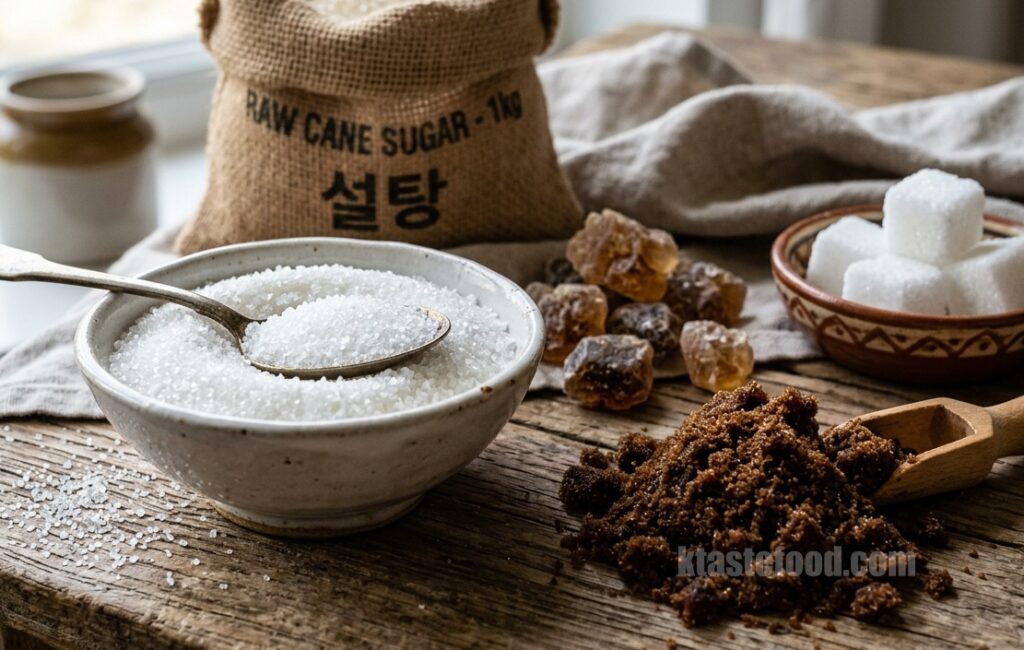
Sweet taste is commonly associated with carbohydrate-rich foods and available energy. In environments where energy could be difficult to obtain, that association had obvious value.
The brain can learn quickly from rewarding food experiences. With repetition, the desire for a food can become linked not only to its taste but also to cues around it: a time of day, a place, a package, a smell, or a familiar routine.
At first: “I enjoyed it when I ate it.”
Later: “I want it before I even taste it.”
This is not unique to food. Human beings learn from many forms of reward—praise, money, entertainment, shopping, games, social media, and social approval.
What am I repeatedly teaching myself to desire?
Taste it in practice: Korean sweetness is not always about intensity. Traditional dishes such as Sikhye and Yaksik show how sweetness can also be tied to grain, celebration, patience, and memory.
Saltiness — Need and Balance
Sodium is physiologically essential. Historically, access to salt was not always as effortless as it is in many modern food environments.
That makes salt a useful metaphor for need: something can be necessary without being better in unlimited amounts.
The question is not always “more.” Sometimes the question is balance.
Money, work, affection, ambition, rest—too little can create longing, while too much can create another kind of imbalance.
Need creates attention. Balance sustains life.
Sourness — Caution and Exploration
Sourness tells us that acidity is present. Depending on context, that can belong to unripe fruit, fermentation, preservation, or foods prized precisely for their brightness and freshness.
Human beings did not simply avoid sourness. We learned fermentation. We made vinegar. We built cuisines around acidity.
What first feels sharp or unfamiliar can, through experience and culture, become something we value.
Be cautious. But do not let caution end exploration.
Taste it in practice: Fermentation is one of the clearest examples of sourness becoming culture. In Authentic Baechu Kimchi, time transforms cabbage, salt, and seasoning into something sharper, deeper, and more complex than the ingredients were at the beginning.
Bitterness — Caution and Learning
Some harmful compounds in nature are bitter, so sensitivity to bitterness can support caution. But bitterness itself is not a simple test for danger: many safe and valued foods are bitter too.
We drink coffee. We eat cacao. We learn to appreciate bitter greens and flavors we may once have rejected.
A taste that begins as unpleasant can become meaningful through experience.
Life can work the same way. Failure, rejection, regret, and disappointment may feel bitter at first, yet some of them become sources of learning.
Not everything unpleasant is dangerous. Sometimes bitterness contains a lesson.
Umami — Nourishment and Fulfillment
Umami is associated especially with glutamate and can be enhanced by certain nucleotides. It appears in foods such as broth, kombu, tomatoes, mushrooms, aged cheese, and many fermented foods.
We often describe these foods as deep, rich, or full.
I like to use that fullness as a metaphor for fulfillment.
Desire asks: “Is there more?”
Fulfillment asks whether what we already have can be enough.
How much is enough to own? How much is enough to eat? How much success is enough?
What does “enough” mean to you?
Taste it in practice: Umami becomes especially clear when ingredients build depth together. Try Shiitake Mushroom Pasta with Doenjang or Umami Abalone Butter Pasta to see how fermented soybean paste, mushrooms, seafood, and fat can create a sense of fullness without relying on sweetness alone.
Five Tastes, Five Questions
- Sweet: What do I desire?
- Salty: What do I need, and where is balance?
- Sour: What am I cautious about exploring?
- Bitter: What am I learning from?
- Umami: When do I feel that I have enough?
These questions return to the table every day.
A meal is not merely an action repeated several times a day. It is a small record of what we choose, what we repeat, what we learn to enjoy, and what we learn to avoid.
Clothing. Food. Shelter.
Perhaps food is the one among them that we have learned to think about too casually.
But food builds the body. Taste builds memory. Repetition builds habit. And habit shapes a human life.
That is why I do not believe that studying taste is simply about asking: “What tastes good?”
The deeper question is: “Why does it taste good to us?”
And perhaps even more importantly: “What kind of life are we shaping through the tastes we repeatedly choose?”
Food began with survival.
Food became a way to care for the body.
Food, repeated, became habit.
And eventually, food became part of the way we live.
Taken together, the five tastes become a metaphor for the full range of human emotion — the joy, sorrow, longing, tension, comfort, and fulfillment that move through a life.
They are also a reminder that life itself is a journey of rises and falls, sharp turns and quiet pauses, detours and discoveries. Just as no meaningful meal is made from a single taste, no meaningful life is made from a single feeling.
The five tastes are, in their own way, the joys and sorrows of life — and the shape of the journey itself.
From Philosophy to the Table
Taste should not remain only an idea. Explore real recipes, ingredients, and cooking methods from K-TASTE in Park’s Kitchen.