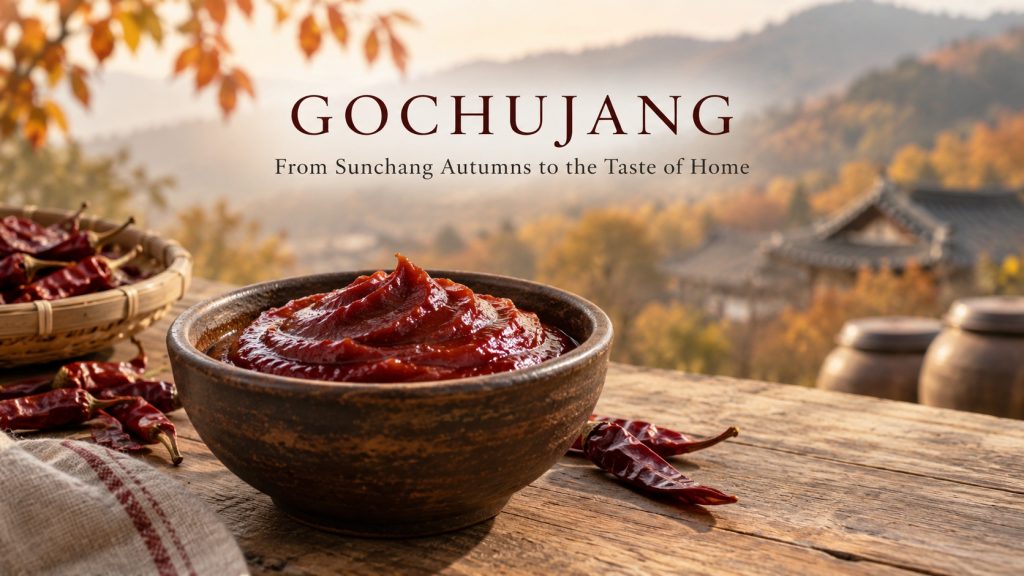
Gochujang: From Sunchang Autumns to the Taste of Home
What it tastes like, how Koreans use it, why Sunchang matters—and why a jar of red paste can sometimes hold the memory of an entire season.
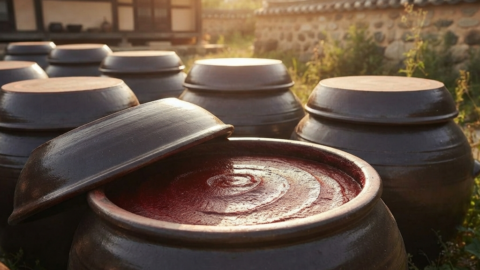
Gochujang is a Korean fermented red chili paste traditionally made with red chili powder, grain, fermented soybean ingredients, and salt.
That is the easy definition.
It is the kind of sentence you can put in a dictionary, on a label, or at the top of a recipe.
But it is not the way I remember gochujang.
I remember autumn.
Twenty or so years ago, you could almost tell the time of year by looking at the color of the village.
The peppers in the fields turned red first.
Soon after, they appeared wherever the sunlight stayed longest—in courtyards, on rooftops, beside country roads, spread across mats and trays to dry.
If rain threatened, somebody gathered them. When the sun returned, somebody spread them out again.
Once they were dry, many families carried them to the neighborhood mill. The peppers came home as freshly ground gochugaru, still carrying that sharp, warm smell that seemed to cling to your clothes.
Then the mornings became colder.
Late autumn had arrived.
And it was time to think about jang.
No one around us called this “artisan fermentation.”
No one called it “local food culture.”
There was no need to give it a name.
It was simply what people did before winter.
Food had to be prepared. Jars had to be filled. Families had to eat.
And in Sunchang, that rhythm of chili, grain, soybean, salt, and waiting belonged to ordinary life.
Before Gochujang Had a Brand, Every House Had Its Own Way
Today, Sunchang and gochujang are almost impossible to separate in the Korean imagination.
But when I think about the Sunchang of my childhood, I do not first think about a famous product.
I think about differences.
The gochujang at one house did not taste exactly like the gochujang next door.
One family might use more glutinous rice. Another family was proud of its meju. Somebody cared deeply about the salt. Another person would say the timing mattered more than anything else.
The peppers were different. The water was different. The weather was never exactly the same.
And, most importantly, the hands were different.
There was no single piece of paper that every mother followed.
There was simply:
This is how our family does it.
Koreans have a word for the kind of knowledge that grows this way.
Sonmat.
Literally, “the taste of the hand.”
My mother rarely measured everything.
She looked, stirred, tasted, and sometimes simply waited.
When I was young, I thought she was guessing.
Now, nearing fifty, I think she had simply done it so many times that her hands knew what I would need a recipe to understand.
Before gochujang was a product, it was a season. Before it had a brand, it belonged to a household.
And before the neighborhood mill made grinding easy, there was harder work.
In Jeolla, many older people remember the stone grinding vessel we called a hakdok.
Peppers, garlic, grains, and other ingredients could be ground against stone by hand.
There was nothing elegant about it.
Your wrist hurt. Your shoulders became stiff. If you kept grinding long enough, your arms could begin to tingle.
Looking back, it is easy to make old foodways sound beautiful.
But the people doing the work were probably not thinking about heritage.
They were tired. They had other things to do. They still had to make dinner.
I am glad much of that labor is gone.
What stayed with me was not the hardship itself.
It was the way a season, a household, and a taste once belonged to one another.
The Heart of Korean Flavor: Authentic Gochujang Recipe
If this story makes you wonder how family-style gochujang is actually put together, this is the natural next page—from memory into the jar itself.
So What Is Gochujang, Really?
Once you remove all the modern packaging, the foundation of gochujang is surprisingly humble.
Red pepper.
Grain.
Fermented soybean.
Salt.
And something that never appears properly on an ingredient label:
time.
The chili gives color and heat.
The grain gives body and, as its starches break down, sweetness.
Fermented soybean ingredients give the paste its deeper savory character.
Salt seasons it and helps create the conditions in which the paste can mature.
But none of those ingredients alone tastes like gochujang.
They have to change together.
That change is the point.
Then the jar is left alone.
That part matters.
There comes a point when the person making gochujang has already done what can be done.
The ingredients have been prepared. The jar has been filled.
After that, there is waiting.
While people go on with ordinary life, the paste changes quietly.
Sharpness softens. Sweetness develops. The separate ingredients begin to taste less separate.
Perhaps that is why gochujang has never felt to me like something that was merely mixed together.
It has spent time becoming itself.
That is also why calling gochujang simply “Korean hot sauce” never feels quite right.
Hot sauce mostly adds heat. Gochujang changes more than that.
What Does Gochujang Taste Like?
The practical answer is:
spicy, gently sweet, salty, and deeply savory.
But good gochujang is less about four separate tastes than about the way those tastes have learned to live together.
The chili does not stand alone.
The sweetness does not sit on top.
The fermented soybean does not announce itself separately.
The flavors seem to arrive already acquainted.
That is why gochujang can work with ingredients as different as pork belly, rice, chicken, squid, potatoes, and salmon.
It has a strong personality.
But when used well, it does not need to dominate.
Used well, gochujang is noticeable.
But the food underneath should still be itself.
How Spicy Is Gochujang?
Usually, less frightening than its deep red color suggests.
Gochujang is certainly spicy, but it is not designed to behave like a pure chili concentrate.
The sweetness of grain and the depth of fermentation soften the heat.
If you are using it for the first time, start with a teaspoon.
Taste.
Then decide.
Adding more gochujang does not only make food hotter.
It also makes it saltier. Sweeter. Thicker. More fermented.
The question is not simply, “How spicy do I want this?”
A better question is:
At what point does this dish stop tasting like itself?
That is usually where you should stop.
How Koreans Actually Use Gochujang
One of the easiest mistakes is to treat gochujang like ketchup.
Straight from the container. Onto everything. More must mean better.
That is rarely how it works.
In Korean cooking, gochujang is often a beginning rather than an ending.
For bibimbap, it can be loosened so that it coats the rice and vegetables rather than sitting heavily on top.
For tteokbokki, it dissolves into broth and becomes part of the cooking liquid.
For meat, it can meet soy sauce, garlic, sesame oil, and sweetness.
In a stew, it may disappear almost completely into the broth.
The philosophy is simple:
let gochujang make the other ingredients more delicious, not less visible.
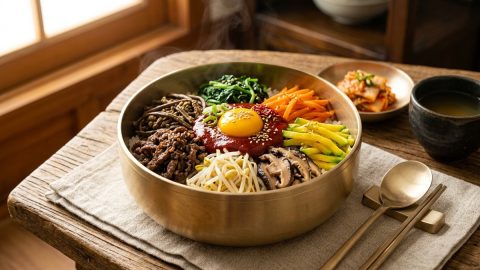
Seven-Jewel Rainbow Bibimbap
Gochujang matters here, but so do the rice, vegetables, sesame, egg, and meat. A good bowl still lets every ingredient remain itself.
In tteokbokki, gochujang moves closer to the center. It dissolves into the broth until the rice cakes, sweetness, heat, and sauce become difficult to separate.
When Gochujang Meets Meat
Fat and fermentation understand each other well.
Pork can carry the depth of gochujang without disappearing beneath it. Chicken gives the sauce something mild to cling to. Garlic and onion become sweeter as they cook.
In osam bulgogi, squid and pork belly share the same pan. They are very different ingredients, but gochujang gives them a place to meet without making them taste the same.
In dakbokkeumtang, the paste behaves differently again. It melts into the cooking liquid and works its way into the chicken, potatoes, and vegetables until it is no longer something sitting on the surface.
Gochujang, Doenjang, Ssamjang and Sriracha
| Condiment | Main character | Typical role |
|---|---|---|
| Gochujang | Spicy, gently sweet, fermented, savory | Sauces, marinades, stews, rice dishes |
| Doenjang | Earthy, salty, soybean-forward | Soups, stews, vegetables, seasoning |
| Ssamjang | Seasoned, nutty, savory | Ready-to-eat dip for grilled meat and wraps |
| Sriracha | Bright chili, garlic, acidity | Finishing hot sauce |
They may sit on the same grocery-store shelf, but they belong to different worlds.
Doenjang and gochujang are relatives in Korea’s jang culture, but they are not substitutes for each other.
Ssamjang is closer to something you can put straight into a lettuce wrap.
Sriracha is useful when you want brightness and heat, but it does not have gochujang’s body or fermented depth.
What Can You Use Instead of Gochujang?
There is no exact replacement.
If a recipe needs only a small amount, you can get part of the way there with a mild fermented paste such as miso, some chili, and a little sweetness.
But if the dish is built around gochujang, use gochujang.
Sometimes the honest answer is simpler than the clever substitute.
How to Store Gochujang
For commercial gochujang, follow the package directions. After opening, refrigeration is the practical choice for most products.
Use a clean, dry spoon and close the lid well.
The surface can darken over time as it meets air.
Darker color alone does not always mean spoilage.
Visible mold, an abnormal smell, or another clear sign of deterioration is different—then it is time to discard it.
From the Jangdokdae to a Modern Kitchen
My mother did not put gochujang on salmon.
There was no reason she would have.
Salmon was not part of the autumn kitchen I remember.
And yet today, I can put the two together and it does not feel strange.
Maybe the important part was never the exact dish.
It was knowing what the ingredient could do, and knowing when to stop.
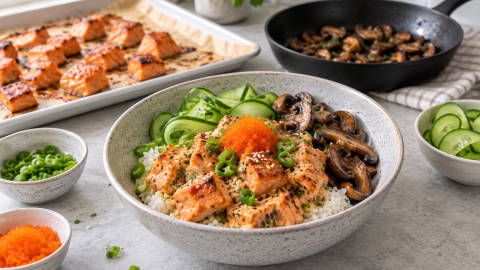
Creamy Gochujang Salmon Rice Bowl with Tobiko
Salmon is rich enough to carry fermented chili, but too much would bury the fish. The point is not to make the salmon taste traditional. It is to let gochujang meet something new without losing its character.
The Autumn I Understand Differently Now
I am getting close to fifty.
Perhaps that is why autumn no longer feels quite the way it did when I was younger.
When the peppers begin to turn red, I do not think only about gochugaru.
I do not think only about gochujang.
I think about what came before the finished jar.
Peppers lying under the afternoon sun.
Someone looking up at the sky because rain might come.
The sound of the neighborhood mill.
The weight of a stone hakdok.
Jars waiting in the yard.
My mother tasting something and deciding it needed a little more time.
Back then, I never thought to ask how she knew.
Now, nearing fifty, I wish I had.
I do not miss the aching wrists.
I do not miss the hours of grinding.
Life became easier, and I am glad it did.
What I miss is smaller.
The connection between a taste and the person who made it.
The small decisions that were never written down.
The knowledge that lived in somebody’s hands until there was no need to explain it.
Maybe that was sonmat.
Not a secret ingredient.
Just years of cooking for the same people, until the hands remembered what the recipe never had to say.
Today, gochujang travels farther than the people who once made it could have imagined.
It appears in pasta, glazes, rice bowls, and kitchens thousands of miles from Sunchang.
I do not mind that.
Food has always moved with people.
What matters to me is that somewhere inside the new dish, we still know where the taste came from.
And every autumn, when the peppers begin to turn red again,
I still think of my mother’s hands.
Want to keep cooking from here?
Explore K-Taste Food by ingredient, memory, or the dish you want to make next.
Quick Answers About Gochujang
What is gochujang made from?
Traditional gochujang is built around Korean red chili powder, a grain or starch component, fermented soybean ingredients, and salt. Exact recipes vary by maker and region.
What does gochujang taste like?
It is spicy, gently sweet, salty, and savory, with a thick texture and a deeper fermented flavor underneath the chili.
How spicy is gochujang?
Heat varies by product. Most gochujang tastes rounder than a pure chili sauce because sweetness and fermentation soften the heat.
Can I use sriracha instead of gochujang?
Sriracha can replace some heat, but not gochujang’s thickness, fermented character, or sweetness. It is not a direct substitute.
Does gochujang need to be refrigerated?
Most opened commercial gochujang is best kept refrigerated. Always follow the storage instructions on the product.
Why is Sunchang famous for gochujang?
Sunchang has a long association with traditional gochujang and a strong local jang-making culture. Its reputation predates modern mass production.